Wednesday, 13 May 2015


Friday, 8 May 2015
Potatoes.
A Simple Way to Get High Yields of Potatoes:
"A Simple Way to Get High Yields of Potatoes"
'via Blog this'
"A Simple Way to Get High Yields of Potatoes"
'via Blog this'
Thursday, 7 May 2015
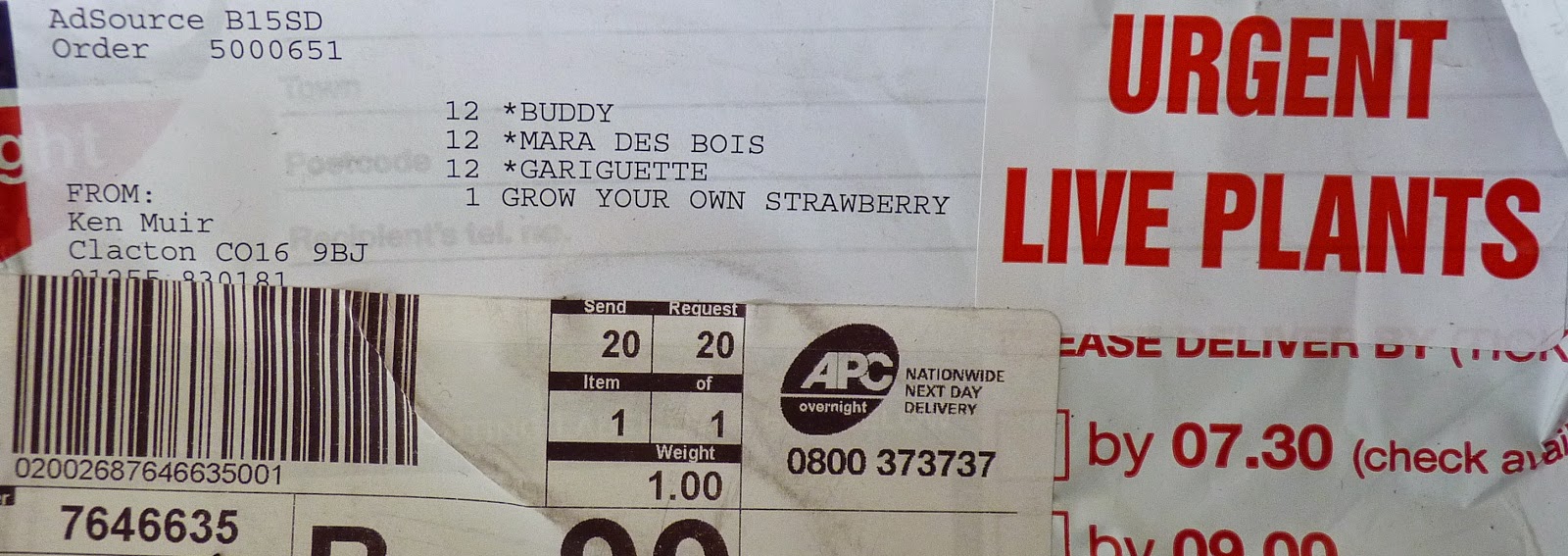
Order Strawberries today!
Re-Order Strawberries today from - Ken Muir!
- Strawberry 'Buddy'
- Strawberry 'Gariguette'
- The perpetual 'Mara des Bois'
cost = £40.16
- Strawberry 'Buddy'
- Strawberry 'Gariguette'
- The perpetual 'Mara des Bois'
cost = £40.16
Wednesday, 6 May 2015
How to grow Strawberry Spinach.
How to grow Strawberry Spinach - Know your Vegetables:
This easy to grow plant produces edibles leaves and fruit - Annual!

An old-fashioned plant that dates to 1600 in Europe.
This curious plant produces greens that are picked and cooked like spinach, but it also produces attractive, red berries that are bland in flavor.
These add a nice touch to fruit salads.
Easy-to-grow plants are similar to “Lamb’s Quarters”, a wild relative.
Found in a monastery garden.
'via Blog this'
This easy to grow plant produces edibles leaves and fruit - Annual!
An old-fashioned plant that dates to 1600 in Europe.
This curious plant produces greens that are picked and cooked like spinach, but it also produces attractive, red berries that are bland in flavor.
These add a nice touch to fruit salads.
Easy-to-grow plants are similar to “Lamb’s Quarters”, a wild relative.
Found in a monastery garden.
'via Blog this'
Homemade Fertilizers.
Lower Lovetts Farm :: Richards Homemade Fertilizers: "Richards Homemade Fertilizers"
Comfrey Liquid (1:50)
I pick the comfrey just before it flowers and cram it into a water butt.
This normally takes 6 to 8 weeks depending on how warm it is. Tip: If you put the tub in the sun it works quicker. You can start using it at this stage.
When you get a green sludge (even more vile smelling a month or so later) I bottle it in 75cl bottles, old screw cap wine bottles. One 75cl bottle will do four watering cans of 2 gallons per can - i..e. one litre to every 10.5 gallons of water (50 litres) or 1:50.
Stinging Nettles Liquid
Wood Ash Liquid
Fill the bucket nearly full with water and stir for three weeks.
With tomatoes I use it once or twice a week, but by August when the tomatoes are at their best I use it every day for a short period.
If you want to keep the plants after a prolonged period of watering with wood ash liquid, add some Epsom salts to the pots and the green will return.
'via Blog this'
Comfrey Liquid (1:50)
I pick the comfrey just before it flowers and cram it into a water butt.
This normally takes 6 to 8 weeks depending on how warm it is. Tip: If you put the tub in the sun it works quicker. You can start using it at this stage.
When you get a green sludge (even more vile smelling a month or so later) I bottle it in 75cl bottles, old screw cap wine bottles. One 75cl bottle will do four watering cans of 2 gallons per can - i..e. one litre to every 10.5 gallons of water (50 litres) or 1:50.
Stinging Nettles Liquid
Wood Ash Liquid
Fill the bucket nearly full with water and stir for three weeks.
With tomatoes I use it once or twice a week, but by August when the tomatoes are at their best I use it every day for a short period.
If you want to keep the plants after a prolonged period of watering with wood ash liquid, add some Epsom salts to the pots and the green will return.
'via Blog this'
Most perfect fertilizer + pesticide is epsom salt.
the world's most perfect fertilizer + pesticide is epsom salt.
This is so true- every other week- 1 gallon of water,
1 TBSP of miracle grow and 3 TBSP of epsom salt.
Studies show that magnesium and sulfur, two major components of Epsom salt, may help plants grow greener with higher yields and more blooms.
Magnesium creates an environment conducive to growth by helping seeds to germinate, increasing chlorophyll production and improving phosphorus and nitrogen uptake.
Dilute a tablespoon of Epsom salt in a gallon of water will do fine.
You can use it a s foliar spray as well for blossom drop at the same dilution.
Some people just sprinkle a little in a ring around the plant.
I thinks as a spray its 2 oz per gallon. I weighted that out at the weekend and 2oz filled about 4 tablespoons - so I put 1 tablespoon in a litre of spray - and that was at least twice what I needed for everything I could think of spraying!
Epsom salts almost certainly cheaper at the Garden centre than the Chemist, but given how little one uses it may be a bit irrelevant
1/2oz of magnesium to 1 pint of water and use it as a foliar spray for magnesium deficient plants. I have used this on yellowing tomato leaves and they green up nicely.
Dissolved in hot water & then soak your feet in it.
Great for hardening up your soles before a walking holiday.
Also read:
35 Pest and Disease Remedies
This is so true- every other week- 1 gallon of water,
1 TBSP of miracle grow and 3 TBSP of epsom salt.
Studies show that magnesium and sulfur, two major components of Epsom salt, may help plants grow greener with higher yields and more blooms.
Magnesium creates an environment conducive to growth by helping seeds to germinate, increasing chlorophyll production and improving phosphorus and nitrogen uptake.
Dilute a tablespoon of Epsom salt in a gallon of water will do fine.
You can use it a s foliar spray as well for blossom drop at the same dilution.
Some people just sprinkle a little in a ring around the plant.
I thinks as a spray its 2 oz per gallon. I weighted that out at the weekend and 2oz filled about 4 tablespoons - so I put 1 tablespoon in a litre of spray - and that was at least twice what I needed for everything I could think of spraying!
Epsom salts almost certainly cheaper at the Garden centre than the Chemist, but given how little one uses it may be a bit irrelevant
1/2oz of magnesium to 1 pint of water and use it as a foliar spray for magnesium deficient plants. I have used this on yellowing tomato leaves and they green up nicely.
Dissolved in hot water & then soak your feet in it.
Great for hardening up your soles before a walking holiday.
Also read:
35 Pest and Disease Remedies
Fertiliser.
Growing vegetables on Leeds allotments - Fertiliser Teas:
Basic Method for "Tea"
Cover material in water, and soak; most recipes "suggest" that you put a lid on the container - this is essential; also do not put the bin by your back door. It will stink.
After a couple of days you will have a weak but useful brew, usable undiluted.
After 2-4 weeks you'll have a stronger brew; this will require a lid and is not suitable for people with short arms!
Stir every couple of days to avoid the brew going stagnant.
Dilute to the colour of weak tea and water in as a plant food, every couple of weeks.
Or use as a spray on plant leaves (a foliar feed).
This process produces a concentrated plant food, and your brew will need to be diluted for use - 1 part tea to 10 parts water for watering in your feed; 1 part tea to 20 parts water to spray on leaves.
Dump the material waste in the compost heap!
Remember - this is only a short-term remedy for plants which need "a bit of a lift"; it won't solve any problems with your soil, as it will be washed away pretty quickly.
Specific Recipes for "tea" brews
Animal Manure
Fill a small sack or cloth bag and suspend this in a container full of water;
rich in nitrogen (especially poultry or pigeon manure) - good for brassicas, onions
Compost
fill a bag or sack, as for animal manure
Seaweed
rinse the seaweed first to get rid of salt
rich in potash (good for potatoes, tomatoes)
Comfrey
cut back the comfrey plants to about 2 inches three or four times a year
pack a dustbin with the cut leaves, and cover with water
rich in potash (good for potatoes, tomatoes), and minerals; good source of nitrogen (for just about anything!)
Nettles
you can make a couple of "harvests" a year from your nettle patch
pack a dustbin with the cut leaves, and cover with water
said to prevent disease, as well as promoting health plant growth
rich in potash (good for potatoes, tomatoes), and minerals; good source of nitrogen (for just about anything!)
Odd recipes
any combinations of the above!
basically anything nitrogen rich, such as fresh grass cuttings
the original cold tea from the teapot! Tea leaves are high in potash
These methods produce a much stronger concentrate, which should be diluted at
1 part potion to 10 or 20 parts water for watering in,
1 part potion to 40 parts water as a spray-on leaf feed.
They also have a couple of advantages, in that they smell less, and the concentrate can be stored (in dark glass bottles, in a cool, dark place.
Using a bucket
Use a plastic container with a hole in the bottom, and fill it with comfrey/nettle leaves. Put a weight on top of the leaves and leave.
After about three weeks a black, very smelly, liquid will drip from the hole.
Collect this in a bottle (shelter the hole and bottle from the rain!).
The concentrate can be stored in the dark for several months.
Using a wormery
The above method is popular among those people who have paid out £50 for a plastic wormery, got fed up with the work involved - and discovered it's perfectly designed for making comfrey concentrate!
Using a piece of drain-pipe!
Fix a drainpipe with wire and brackets to garage wall;
Wedge a 6-pint milk bottle and funnel underneath the drainpipe;
Stuff the drainpipe with comfrey or nettle leaves;
Put a plastic pop-bottle full of water in the top of the drainpipe (attached to a length of string); this will compress the leaves down the drainpipe;
and the concentrate will drip into the bottle, while the funnel keeps the leaves back.
'via Blog this'
Basic Method for "Tea"
Cover material in water, and soak; most recipes "suggest" that you put a lid on the container - this is essential; also do not put the bin by your back door. It will stink.
After a couple of days you will have a weak but useful brew, usable undiluted.
After 2-4 weeks you'll have a stronger brew; this will require a lid and is not suitable for people with short arms!
Stir every couple of days to avoid the brew going stagnant.
Dilute to the colour of weak tea and water in as a plant food, every couple of weeks.
Or use as a spray on plant leaves (a foliar feed).
This process produces a concentrated plant food, and your brew will need to be diluted for use - 1 part tea to 10 parts water for watering in your feed; 1 part tea to 20 parts water to spray on leaves.
Dump the material waste in the compost heap!
Remember - this is only a short-term remedy for plants which need "a bit of a lift"; it won't solve any problems with your soil, as it will be washed away pretty quickly.
Specific Recipes for "tea" brews
Animal Manure
Fill a small sack or cloth bag and suspend this in a container full of water;
rich in nitrogen (especially poultry or pigeon manure) - good for brassicas, onions
Compost
fill a bag or sack, as for animal manure
Seaweed
rinse the seaweed first to get rid of salt
rich in potash (good for potatoes, tomatoes)
Comfrey
cut back the comfrey plants to about 2 inches three or four times a year
pack a dustbin with the cut leaves, and cover with water
rich in potash (good for potatoes, tomatoes), and minerals; good source of nitrogen (for just about anything!)
Nettles
you can make a couple of "harvests" a year from your nettle patch
pack a dustbin with the cut leaves, and cover with water
said to prevent disease, as well as promoting health plant growth
rich in potash (good for potatoes, tomatoes), and minerals; good source of nitrogen (for just about anything!)
Odd recipes
any combinations of the above!
basically anything nitrogen rich, such as fresh grass cuttings
the original cold tea from the teapot! Tea leaves are high in potash
These methods produce a much stronger concentrate, which should be diluted at
1 part potion to 10 or 20 parts water for watering in,
1 part potion to 40 parts water as a spray-on leaf feed.
They also have a couple of advantages, in that they smell less, and the concentrate can be stored (in dark glass bottles, in a cool, dark place.
Using a bucket
Use a plastic container with a hole in the bottom, and fill it with comfrey/nettle leaves. Put a weight on top of the leaves and leave.
After about three weeks a black, very smelly, liquid will drip from the hole.
Collect this in a bottle (shelter the hole and bottle from the rain!).
The concentrate can be stored in the dark for several months.
Using a wormery
The above method is popular among those people who have paid out £50 for a plastic wormery, got fed up with the work involved - and discovered it's perfectly designed for making comfrey concentrate!
Using a piece of drain-pipe!
Fix a drainpipe with wire and brackets to garage wall;
Wedge a 6-pint milk bottle and funnel underneath the drainpipe;
Stuff the drainpipe with comfrey or nettle leaves;
Put a plastic pop-bottle full of water in the top of the drainpipe (attached to a length of string); this will compress the leaves down the drainpipe;
and the concentrate will drip into the bottle, while the funnel keeps the leaves back.
'via Blog this'
Окопник.
Садовое обозрение - Окопник – не сорняк, а друг садовода:

- настой травы окопника – это лучшее органическое калийное удобрение.
Как раз регулярное скашивание травы окопника и позволяет держать его заросли в рамках приличия.
А трава помогает эффективно поставлять калий для томатов, перцев, картофеля и прочих любителей этого элемента питания, без полноценного калийного удобрения трудно добиться хорошего завязывания и вызревания плодов.
Вот мой рецепт эффективного калийного удобрения:
- листья окопника порубить, сложить в бочку и залить дождевой водой (на 1 кг листьев 10 л воды).
Накрыть бочку крышкой и настаивать на солнечном месте неделю.
Поливать растения настоем, разбавленным водой в пропорции 1:10.
Особенно хороши такие подкормки для растений, выращиваемых в контейнерах или нуждающихся в калии.
Если окопника много, то можно скосить траву, порубить и использовать как мульчу для посадок томатов, фасоли и горошка.
Такая мульча отлично подходит для земляники и молодых плодовых деревьев.
Только обязательно кладите ее на влажную и рыхлую почву, а поверх слегка присыпайте сухой землей или торфом.
'via Blog this'
- настой травы окопника – это лучшее органическое калийное удобрение.
Как раз регулярное скашивание травы окопника и позволяет держать его заросли в рамках приличия.
А трава помогает эффективно поставлять калий для томатов, перцев, картофеля и прочих любителей этого элемента питания, без полноценного калийного удобрения трудно добиться хорошего завязывания и вызревания плодов.
Вот мой рецепт эффективного калийного удобрения:
- листья окопника порубить, сложить в бочку и залить дождевой водой (на 1 кг листьев 10 л воды).
Накрыть бочку крышкой и настаивать на солнечном месте неделю.
Поливать растения настоем, разбавленным водой в пропорции 1:10.
Особенно хороши такие подкормки для растений, выращиваемых в контейнерах или нуждающихся в калии.
Если окопника много, то можно скосить траву, порубить и использовать как мульчу для посадок томатов, фасоли и горошка.
Такая мульча отлично подходит для земляники и молодых плодовых деревьев.
Только обязательно кладите ее на влажную и рыхлую почву, а поверх слегка присыпайте сухой землей или торфом.
'via Blog this'
Comfrey.
Comfrey (Symphytum species) is essential to organic gardening.:
Mulch
Use the leaves in layers about 5 cm thick over the surface of the soil.
The leaves break down rapidly and provide nutrients to the crops.
Comfrey is particularly good for fruiting crops because of the good levels of potash.
When planting potatoes, lay comfrey leaves in the bottom of the trench and place the potatoes on top.
Or plant clumps of comfrey in the orchard. The leaves are then regularly slashed or mown and left on the surface of the soil to break down.
Comfrey liquid manure
Fill a large container with comfrey leaves, cover with water and a lid and leave for four weeks.
Leaves readily de-compose making a very useful (if extremely malodorous) liquid manure.
This fast-acting liquid food can be used as it is on established plants or diluted about 5 to 1, and used for seedlings, pots, and ailing plants.
Alternatively, firmly pack comfrey leaves into a wide pipe, weight with a stone and suspend the pipe above a small container.
The pipe should be blocked at the bottom end with just a small hole in the middle.
The comfrey leaves rot down releasing a dark liquid that collects in the small container.
Dilute this by about 15 to 1 and use in the same way as liquid manure.
Compost activator
Comfrey added to the compost not only rots down quickly but also adds nutrients and speeds up the decomposition of other materials.
I grow one clump of comfrey near the compost to remind me to add a leaf every time I add other materials.
Other plants in the Boraginaceae family, like borage and forget-me-nots, also break down quickly in the compost.
Weed barrier
Comfrey is used as a weed barrier because it is able to stop running grasses from spreading.
It needs to be planted in a strip several plants wide and it’s important to use only non-seeding, non-spreading varieties otherwise you will only be replacing one weed problem with another.
Slug and snail trap
Comfrey growing in big tubs to keep it under control
Grow comfrey near the compost
Big comfrey leaves are attractive to slugs and, to a lesser extent, snails.
So try layering the leave around but some distance from young seedlings.
Each morning pick up the leaves and remove the slugs and snails that are sheltering and feeding there.
Drop these into soapy water and replace the leaves to trap more slugs.
Mulch
Use the leaves in layers about 5 cm thick over the surface of the soil.
The leaves break down rapidly and provide nutrients to the crops.
Comfrey is particularly good for fruiting crops because of the good levels of potash.
When planting potatoes, lay comfrey leaves in the bottom of the trench and place the potatoes on top.
Or plant clumps of comfrey in the orchard. The leaves are then regularly slashed or mown and left on the surface of the soil to break down.
Comfrey liquid manure
Fill a large container with comfrey leaves, cover with water and a lid and leave for four weeks.
Leaves readily de-compose making a very useful (if extremely malodorous) liquid manure.
This fast-acting liquid food can be used as it is on established plants or diluted about 5 to 1, and used for seedlings, pots, and ailing plants.
Alternatively, firmly pack comfrey leaves into a wide pipe, weight with a stone and suspend the pipe above a small container.
The pipe should be blocked at the bottom end with just a small hole in the middle.
The comfrey leaves rot down releasing a dark liquid that collects in the small container.
Dilute this by about 15 to 1 and use in the same way as liquid manure.
Compost activator
Comfrey added to the compost not only rots down quickly but also adds nutrients and speeds up the decomposition of other materials.
I grow one clump of comfrey near the compost to remind me to add a leaf every time I add other materials.
Other plants in the Boraginaceae family, like borage and forget-me-nots, also break down quickly in the compost.
Weed barrier
Comfrey is used as a weed barrier because it is able to stop running grasses from spreading.
It needs to be planted in a strip several plants wide and it’s important to use only non-seeding, non-spreading varieties otherwise you will only be replacing one weed problem with another.
Slug and snail trap
Comfrey growing in big tubs to keep it under control
Grow comfrey near the compost
Big comfrey leaves are attractive to slugs and, to a lesser extent, snails.
So try layering the leave around but some distance from young seedlings.
Each morning pick up the leaves and remove the slugs and snails that are sheltering and feeding there.
Drop these into soapy water and replace the leaves to trap more slugs.
Subscribe to:
Posts (Atom)